How a new line reaches a street, and why it takes so long
Between an announcement and a working connection sits a sequence of permits, surveys and physical work that rarely appears in the announcement.
By Theodore Ashgrove · Access & Infrastructure
8 min readReported from Columbus, OH
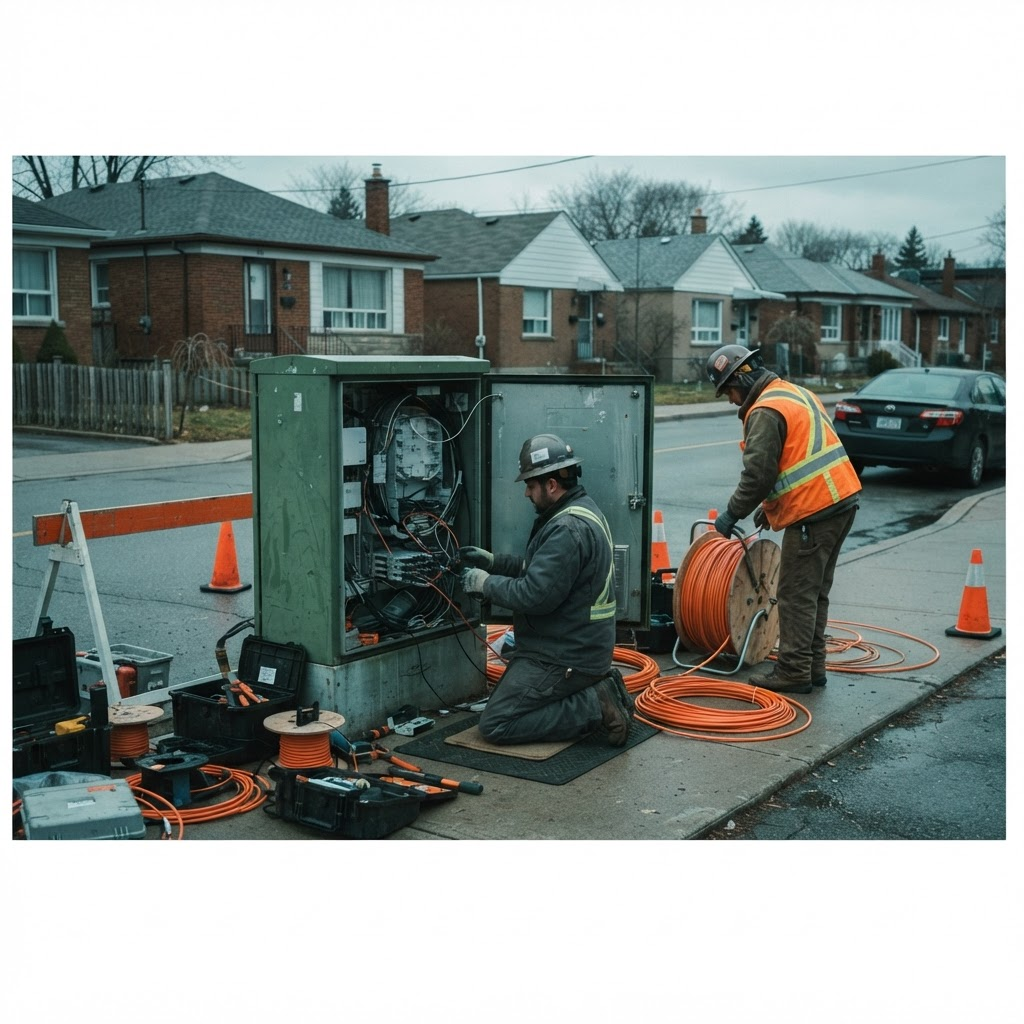
A build announcement gives a year. Residents reasonably read that as a date. The gap between the two is filled with work that is unglamorous, sequential, and almost entirely invisible from the pavement.
The sequence
Design comes first: a route is drawn, and every pole, duct and crossing along it is identified. Then the route has to be permitted, which involves the road authority and, where poles are shared, the owner of those poles. Existing attachments sometimes have to be rearranged before a new one can be added, and that rearrangement is a separate job with its own schedule.
Only then does construction begin, and construction is itself two stages: the main route along the street, and the individual drop from the street to each building. A household can watch a crew work outside for a week and still not be connected, because the drop is a different crew and a different queue.
What residents can usefully ask
- Whether the address is inside the funded footprint or adjacent to it, which are different things.
- Which stage the route is currently in: design, permitting, construction or connection.
- Whether the building requires internal work, which is often the resident’s responsibility and often the longest delay.
None of this makes waiting shorter. It does make the wait legible, and it turns a vague grievance into a specific question that a project office can answer.
What informed this article
- Municipal permitting records and published build documentation — Referenced for the sequence of design, permitting and construction stages.
Theodore Ashgrove
Access & Infrastructure
Theodore covers broadband build-outs, municipal fibre projects and the mechanics of how connections reach a street address.
Corrections
If anything here is inaccurate or out of date, tell us and we will correct it and note the change on the article. Write to editorial@mywifiguide.com.
General information for a general audience. Not professional advice, and not a recommendation to buy any product or service.